
How To Raise Emotionally Resilient Kids In A Digital World
Parenting has always been a demanding role — but today’s world introduces challenges that previous generations never had to navigate. From social media pressures to academic expectations, from global unrest to everyday stress, children and teens are facing more emotional complexity than ever before.
The good news? Emotional resilience isn’t something kids are born with or without.
It’s a skill they can learn – and parents play a powerful role in shaping it.
At Innova Therapy, we support families in building resilience, coping skills, and confident communication. In this post, we’ll look at why resilience matters, what gets in the way, and how parents can help their children grow stronger from the inside out.
What is Emotional Resilience?

Emotional resilience is the inner capacity that helps children move through life’s challenges with greater steadiness and confidence. It’s not about avoiding stress or never having big feelings. It is about having the skills and support to navigate those moments in a healthy way.
At its core, emotional resilience involves the ability to:
Manage difficult feelings without becoming overwhelmed
Kids who are resilient can experience fear, anger, sadness, or frustration while staying connected to their coping tools, rather than shutting down or spiralling. They learn how to soothe their nervous system and regain their balance.
Recover from setbacks
Whether it’s a conflict with a friend, a disappointing grade, or a tough day at school, resilient children don’t feel “stuck” in the setback. They’re able to name how they feel, express it safely, and find a path forward.
Adapt to change
Transitions — new teachers, new schools, shifting friendships, family changes — can be incredibly stressful for kids. Resilience allows them to adjust more smoothly and trust that they can handle what comes next.
Stay connected to themselves and others during stress
Instead of shutting down, lashing out, or withdrawing, resilient kids learn how to stay grounded enough to communicate, ask for help, and remain in relationship with the people who support them.
Why Resilience Matters More Than Ever
Children today are growing up in an environment that’s fast-paced, unpredictable, and digitally saturated. They’re exposed to more information — and more stimulation — than their brains are developmentally prepared for.
Some of the most common challenges we see in therapy include:
Social media overwhelm
Comparisons, cyberbullying, FOMO, and the pressure to always be “on.”
Academic and performance pressure
Kids feel they must excel at everything: school, sports, friendships, extracurriculars.
Reduced unstructured play
Play builds creativity, problem solving, and emotional regulation — but children have less downtime than ever.
Post-pandemic social challenges
Many children feel socially behind, anxious in groups, or unsure how to navigate peer dynamics.
Global uncertainty
Kids hear about climate change, violence, economic stress, and world conflict — sometimes without fully understanding it.
When these stressors pile up, children can experience anxiety, emotional outbursts, withdrawal, sleep changes, or difficulty coping with everyday frustrations.
Resilience gives them the tools to manage all of this with greater confidence and stability.
How Parents Can Build Emotional Resilience in Their Children
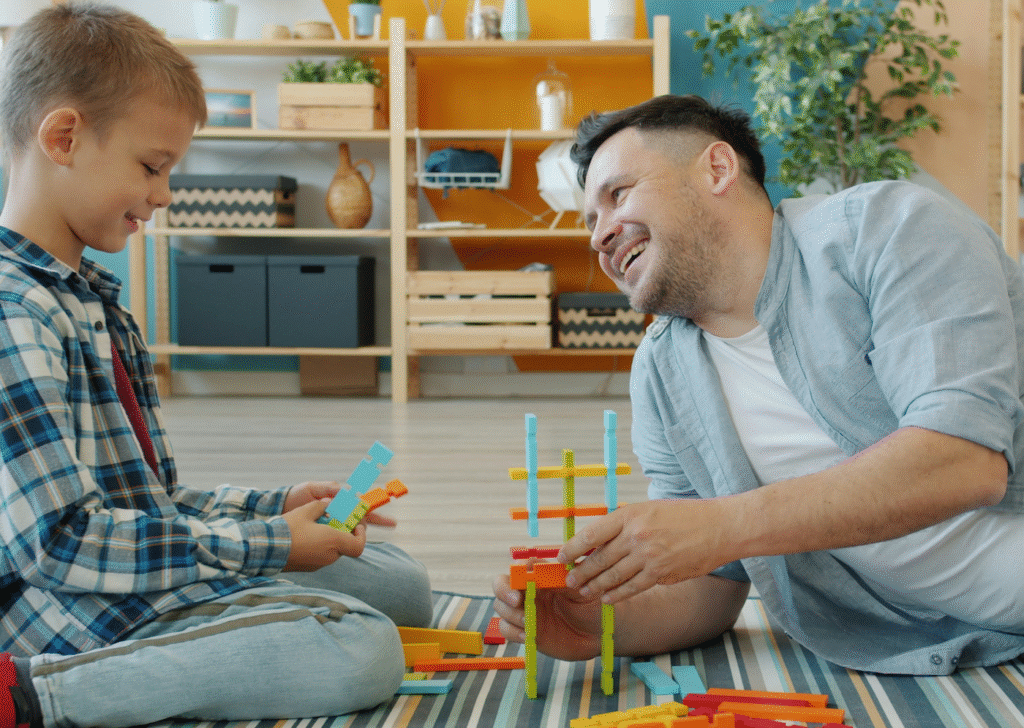
Below are evidence-informed strategies that therapists often teach and reinforce in counselling sessions.
You may already be doing some of these – others might become helpful new tools.
Model Healthy Emotional Regulation
Children learn far more from what we practice than what we say.
If you cope by shutting down, yelling, overworking, or ignoring your needs, kids internalize those patterns.
But when you show that it’s okay to take a pause, breathe, or ask for help, they learn the same.
What this can look like:
Using coping tools in front of them
Repairing after conflict: “I reacted too quickly. I’m sorry. Let’s try again.”
Therapy often helps parents build their own regulation skills first — which directly supports their children’s resilience.
Teach Emotional Literacy
Kids can’t cope with feelings they can’t name. Emotional literacy gives them language and understanding.
- Using a feelings chart with younger children
- Asking: “Where do you feel that in your body?”
- Validating their experience instead of minimizing it
- Helping them differentiate between similar emotions (e.g., overwhelmed vs. angry)
When kids understand what they’re feeling, they’re much better equipped to handle it.
Create Predictable Routines
Consistency reduces anxiety.
- morning and bedtime habits
- homework or activity schedules
- device-free times
- regular meals
- weekly family check-ins
Predictability makes the world feel less chaotic — especially for neurodivergent children.
Support Healthy Digital Habits
Digital life isn’t “bad” — but unmanaged digital life can be overwhelming.
- device-free zones (mealtimes, bedrooms)
- agreed-upon time limits
- conversations about what they’re seeing online
- boundaries around notifications
The goal isn’t perfection, it’s balance and awareness.
Encourage Problem-Solving Instead of Fixing Everything
Parents often want to protect their children from discomfort. But the more we solve their problems for them, the less confident they feel in their own abilities.
- “What options do you see?”
- “How do you want to handle this?”
- “Let’s brainstorm solutions together.”
- “What could you try next time?”
Supporting problem-solving builds confidence, perseverance, and independence.
Make Space for Open and Consistent Conversations
Resilience grows in relationships — not in isolation.
- “How was your heart today?”
- “What felt hard today?”
- “What are you proud of?”
- “Anything you need help with?”
If a child knows they can talk to you without fear of judgment or punishment, they’re more likely to share their true feelings.
When Counselling Helps Build Resilience
Sometimes, even the healthiest families need extra support, especially when kids are dealing with:
- anxiety or overstimulation
- emotional outbursts or shutdowns
- friendship difficulties
- perfectionism
- school refusal
- changes in the family (new baby, separation, relocation)
- social media stress
- neurodiversity-related challenges
At Innova Therapy, we support children, teens, and parents through:
A safe, developmentally appropriate way for younger children to express emotions and build coping skills.
Helping adolescents manage stress, identity struggles, social pressure, and digital overwhelm.
Practical guidance for communication, emotional regulation, and parenting challenges.
Family Therapy
Strengthening connection, understanding, and communication between family members.
Therapy provides kids and parents the tools needed to navigate challenges with confidence.
A Real-Life Example
Through a combination of:
- individual therapy for their daughter
- parent coaching
- improving family communication and routines
…she learned to identify her triggers, express her needs, and use coping tools when anxious. Her parents learned to validate her emotions, set gentle boundaries, and respond with calm instead of panic.
Within months, the entire household felt more grounded, connected, and resilient.
This is the power of working as a team.
Helping Your Child Thrive Starts With Support for You
You don’t need to have all the answers. No parent does.
What matters most is showing up, staying curious, and being willing to learn alongside your child. With the right tools and support, families can grow stronger, even during difficult or uncertain times.
If you’d like help navigating emotions, behaviour challenges, digital overwhelm, or parenting stress, our team at Innova Therapy is here for you.
Book a free 15-minute consultation.
Let’s talk about what’s going on at home and how we can support your family.
Child & Family Counsellors in Coquitlam

PJ Lewis
PJ Lewis, RCC-ACS, CCC, CCS, Clinical Director, Innova Therapy Inc.

Bonnie Cheng, RCC
Bonnie Cheng, RCC | Innova Therapy Coquitlam & Online
Child & Family Counsellors in Maple Ridge

PJ Lewis
PJ Lewis, RCC-ACS, CCC, CCS, Clinical Director, Innova Therapy Inc.
Bonnie Cheng, RCC
Bonnie Cheng, RCC | Innova Therapy Coquitlam & Online

Andrea Pastoor RCC
Andrea Pastoor, RCC | Innova Maple Ridge, Coquitlam & Online